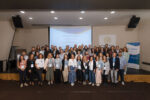
On 16–17 June 2026, the EURoma Network held a study visit in Ostrava (Czechia) focused on housing and residential desegregation. The meeting brought together representatives from national, regional and local authorities, civil society organisations and European institutions to exchange experiences and learn from the “Ostrava case”. This study visit is part of the EURoma Network’s housing strand and follows the first visit held in Collegno (Italy).
After initial welcoming words by the Deputy Mayor of Ostrava, the visit opened with an overview of the housing situation of Roma in Czechia. A representative of the European Union Agency for Fundamental Rights (FRA) presented key findings on Roma housing conditions, drawing on data from the recent FRA Roma Survey 2024, highlighting persistent challenges such as discrimination and unequal access to adequate housing.
Participants then turned to the local level to better understand the specific context of Ostrava, a city facing significant housing challenges, including limited public housing stock, high levels of housing needs and patterns of residential segregation.
The core of the study visits focused on the Social Rental Agency (SRA) model as implemented in Ostrava, with particular attention to the work of Romodrom, a civil society organisation whose programmes target Roma communities. Its experience was central to the discussions, showcasing how the model helps overcome key barriers that Roma face in accessing housing, including discrimination in the private rental market. By working directly with landlords and providing social support to tenants, the organisation facilitates access to standard housing for families who would otherwise be excluded.
Participants had the opportunity to explore how this approach works in practice, including through a keynote presentation and dedicated sessions focusing on key elements such as access to housing mediation on the private market and social support accompanying tenants.
The visit also benefited from contributions by other actors implementing similar or complementary approaches, including the City of Liberec, and other NGO, such as Portavita and Silesian Diakonie. These perspectives enriched the discussion by presenting different operational models and experiences, allowing participants to compare approaches and identify common challenges and solutions.
A dedicated session addressed the perspective of public authorities, highlighting how Czechia has built a new Housing Support Act drawing on the lessons of pilot projects implementing the SRA model. Representatives from the Ministry of Labour and Social Affairs and the Ministry for Regional Development shared how these experiences have informed the development of a more systemic, state-level framework to support access to housing, alongside instruments to assist municipalities in its implementation, as well as the key role played by the ESF in supporting such housing initiatives.
Beyond the presentations, the study visit created space for exchange, in which participants reflected on the key features of the Ostrava case and explored how elements of the SRA model (particularly those targeting Roma communities) could be adapted to different national and local contexts.
This meeting marks a further step within the housing strand of EURoma Network, contributing to a growing collection of case studies aimed at building shared knowledge on how to promote better initiatives for guaranteeing equal access of Roma to the right to housing and particularly, to effectively tackled housing desegregation.
This EURoma meeting was been supported by the European Centre of Competence for Social Innovation.